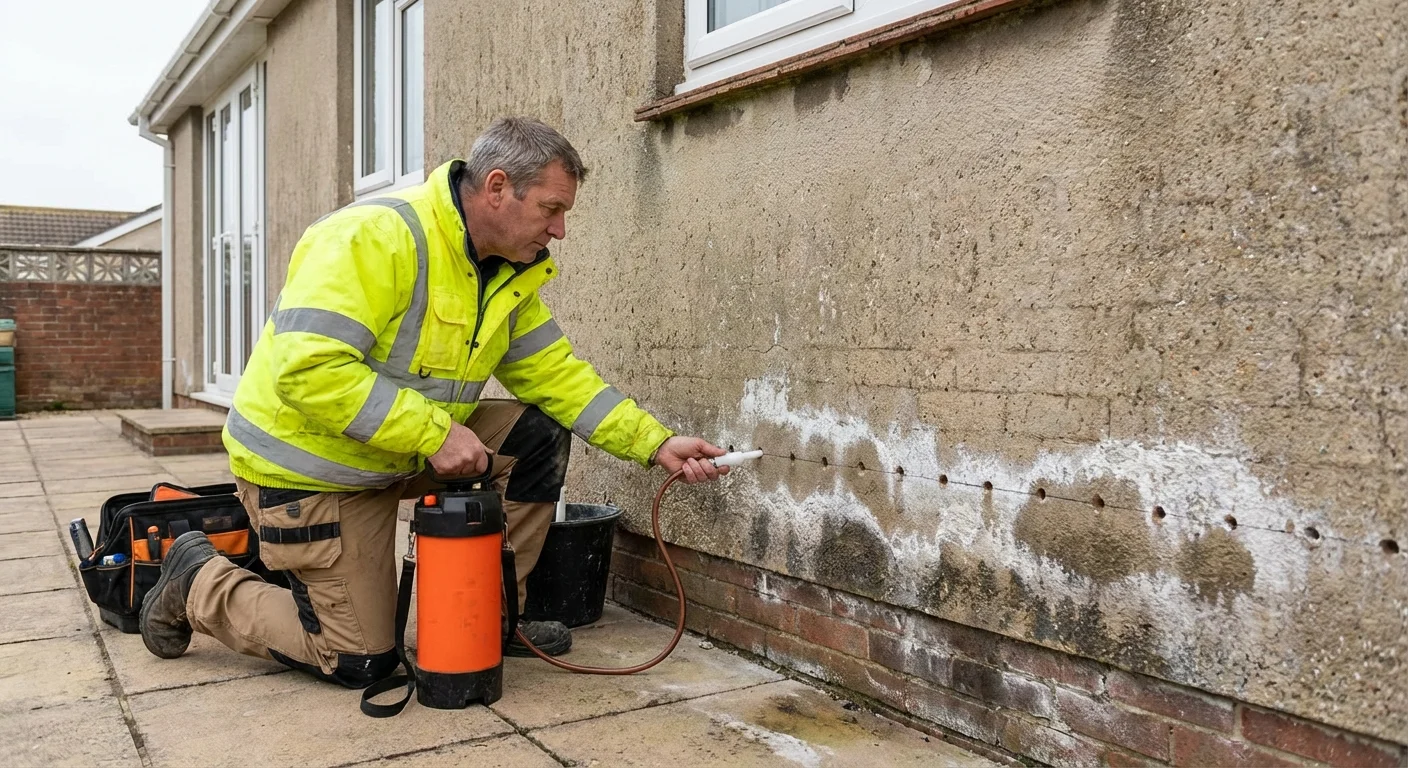
Chemical DPC injection for rising and penetrating damp. Free survey and fixed price quote across Manchester, Tameside, Stockport, Trafford, Oldham, Rochdale, Wigan, Bolton and Bury.
Rising damp is the upward movement of moisture through a wall or floor by capillary action. Ground moisture is drawn up through the pores of bricks and mortar in the same way water travels up a wick. In a property with an intact, effective damp proof course, this process is blocked at a low level in the wall. In properties where the DPC has failed, been bridged or where no DPC exists, moisture continues to rise.
Greater Manchester has a significant stock of Victorian and Edwardian housing. Many of these properties were built with slate, lead or bitumen DPC materials that have deteriorated over 100 years or more. Others have had render, paving or raised flowerbeds installed against external walls, effectively bridging the DPC and allowing moisture to bypass it.
Rising damp causes staining, salt crystallisation, paint failure and plaster deterioration. It is a structural issue that will not resolve itself and will progressively worsen if left untreated. However, it is important to note that rising damp is less common than many property owners are told. Condensation damp is responsible for the vast majority of mould and moisture problems in UK homes. We carry out a proper survey before recommending any DPC work.
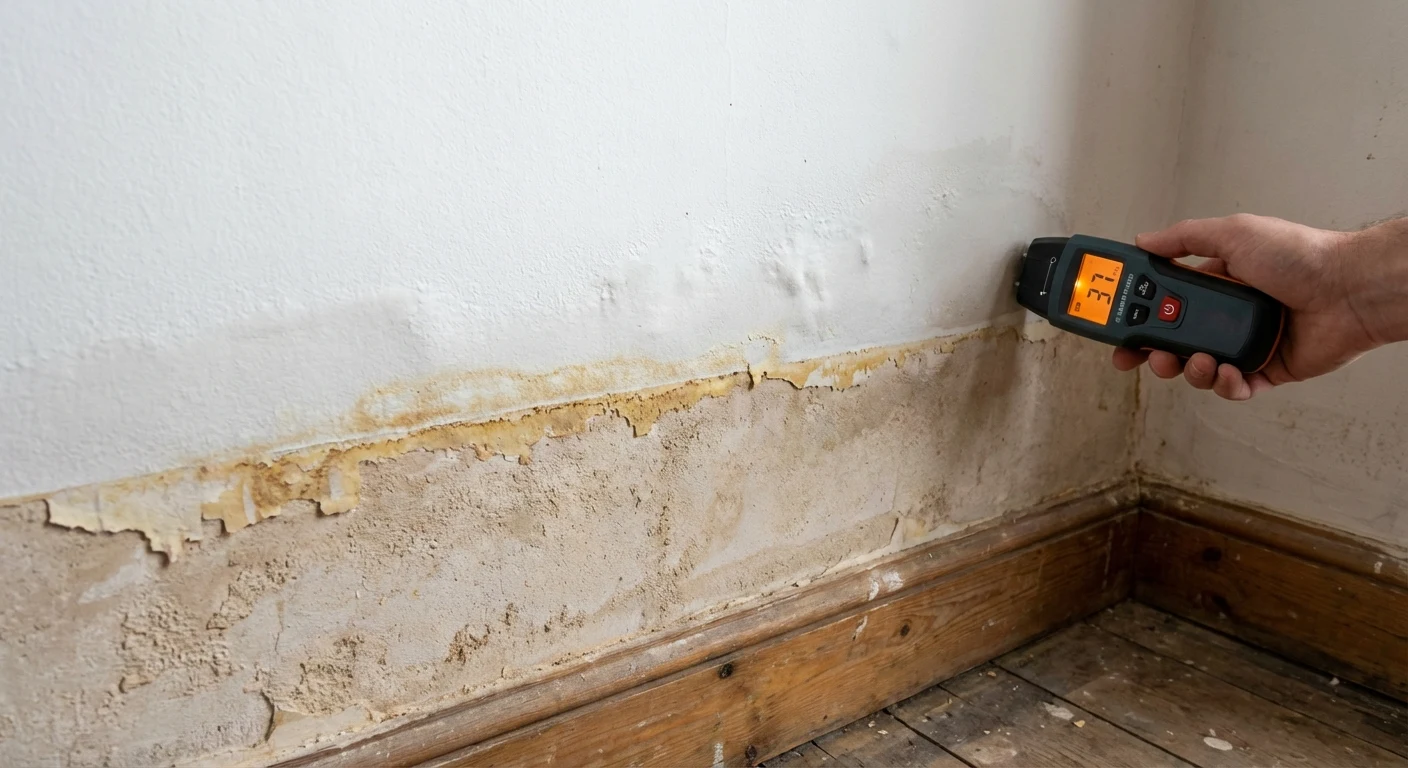
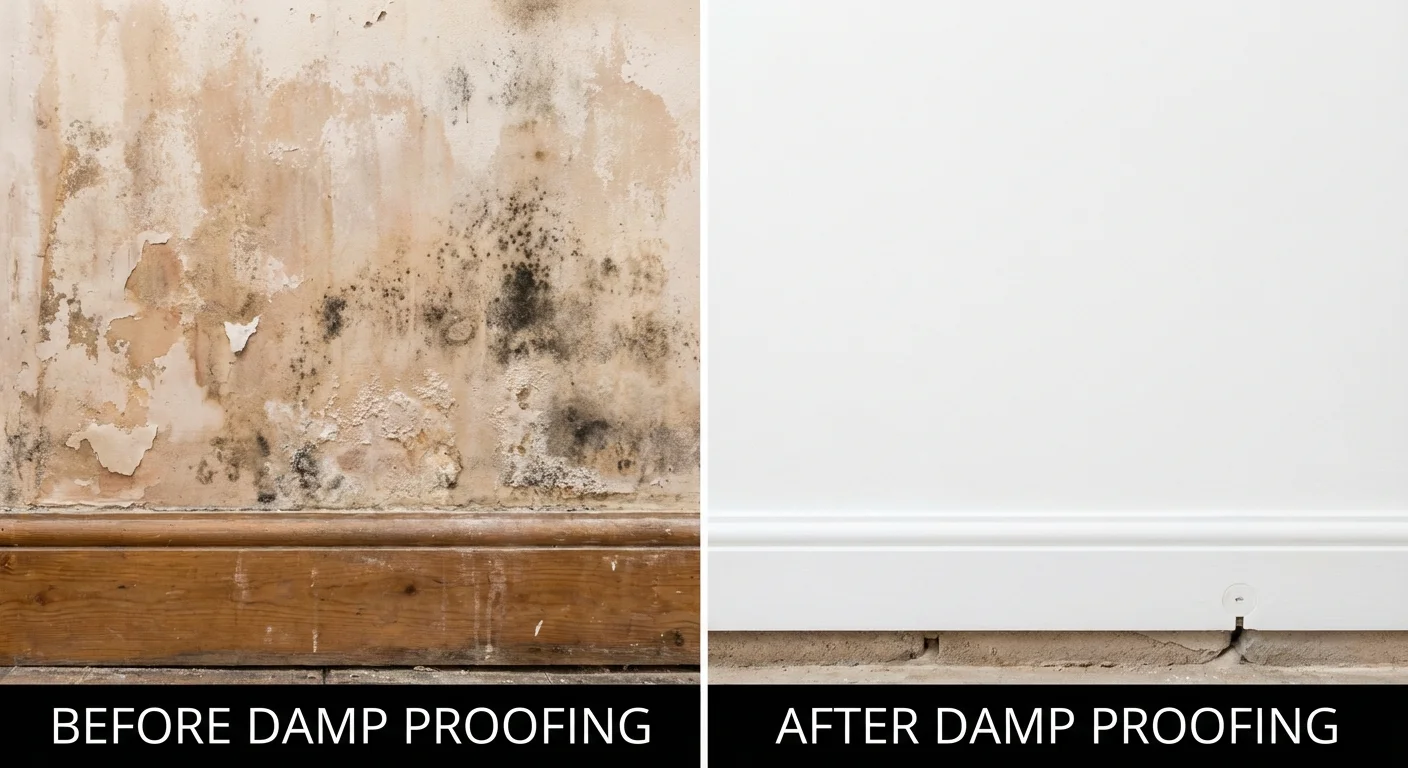
These are the characteristic signs of genuine rising damp. If you are seeing these, a survey is worthwhile. If what you are seeing does not fit this pattern, it is more likely to be condensation or penetrating damp, both of which have different solutions.
A distinct line of staining or discolouration on lower walls, typically between 0.5m and 1m from the floor. May be accompanied by white salt crystallisation (efflorescence).
White or yellowish fluffy deposits on internal plaster surfaces. These are salts carried up from the ground by rising moisture. Surfaces may feel damp to the touch in wet weather.
Paint bubbling, plaster blowing or crumbling at the base of walls, particularly on external-facing walls. Skirting boards may be rotting or detaching from the wall.
Rising damp is driven by ground moisture levels, which are highest in winter. If the problem is noticeably worse in wet months, rising damp is more likely than condensation.
Mould from rising damp tends to appear low on walls, within the area affected by moisture. Condensation mould tends to spread more broadly across cold surfaces at any height.
If DPC work has been carried out previously and the damp has returned, the original treatment may have been incorrectly specified or the DPC may have been bridged by subsequent works.
Chemical injection is the most widely used and reliably effective method of treating rising damp in existing buildings. Here is what the process involves from survey to completion.
We attend the property and take moisture readings using a calibrated electronic moisture meter. We measure at multiple points along the affected walls and at varying heights to establish the extent of the problem and to confirm it is rising damp rather than condensation or penetrating damp. This is free of charge.
A series of holes are drilled into the mortar course at a consistent height, typically 100-150mm above external ground level. Holes are spaced at 120mm centres and angled slightly downward to allow the chemical to penetrate effectively. Drilling is dusty but not structurally damaging.
A silane or silicone cream is injected into each hole using a pressure system. The cream diffuses through the masonry and cures to form a continuous water-repellent barrier. Cream-based systems are preferred over liquid injection as they remain in place more effectively and penetrate more evenly.
Salt-contaminated plaster is removed to a height at least 300mm above the visible tide mark. The wall is allowed to dry for several weeks before a renovating plaster or sand and cement render is applied. This prevents salts from the original plaster contaminating the new surface.
The wall must be allowed to dry before redecoration. Drying times vary by wall thickness and moisture level, typically three to six months for a solid brick wall. We advise on appropriate redecoration timescales and suitable paint types for the area.
DPC injection pricing is based on the linear metres of wall requiring treatment. The minimum job size is 4 linear metres. All prices are fixed after a free survey and include the chemical injection process. Replastering is quoted separately based on the extent of plaster removal required.
Chemical DPC injection involves drilling a series of holes at regular intervals along the base of an affected wall and injecting a silane or silicone-based cream or liquid into the masonry. The chemical penetrates the brick or block and creates a water-repellent barrier that prevents moisture from rising further up the wall. It is the most widely used and effective method of treating rising damp in existing buildings.
Rising damp typically presents as a tide mark of moisture and salt crystallisation on lower walls, usually no higher than 1 metre from the floor. The staining tends to be worst in winter when ground moisture is highest. Condensation damp, by contrast, appears on cold surfaces at any height, particularly on external walls and window reveals, and is associated with mould growth. A proper survey will distinguish between the two. Treating the wrong type is a waste of money.
In most cases yes. Rising damp carries soluble salts from the ground into the plaster. These salts remain hygroscopic even after the DPC is installed, meaning they continue to absorb moisture from the air and may cause further damage or prevent effective redecoration. Salt-contaminated plaster should be removed to a height at least 300mm above the tide mark and replaced with a renovating or sand and cement render.
The chemical injection itself takes effect relatively quickly, but the wall must dry out before it can be effectively replastered or redecorated. Drying times depend on the thickness of the wall, the extent of saturation and the time of year. A typical solid brick wall may take three to six months to dry sufficiently. We advise on appropriate drying timescales and suitable renovation plaster systems.
Genuine rising damp exists but is less common than many survey companies suggest. A significant proportion of properties diagnosed with rising damp actually have condensation damp, which has a completely different solution. We carry out thorough moisture testing before recommending any DPC work, because we will not recommend work that is not needed.
We cover Manchester, Tameside, Stockport, Trafford, Lancashire, Oldham, Rochdale, Wigan, Bolton, Bury and all surrounding areas. Call 07791 561944 to arrange a free survey.
Call for a survey and fixed price quote. We cover Manchester, Tameside, Stockport, Trafford, Lancashire, Oldham, Rochdale, Wigan, Bolton and Bury.
07791 561944Mon-Fri 8am-6pm, Sat 9am-4pm